


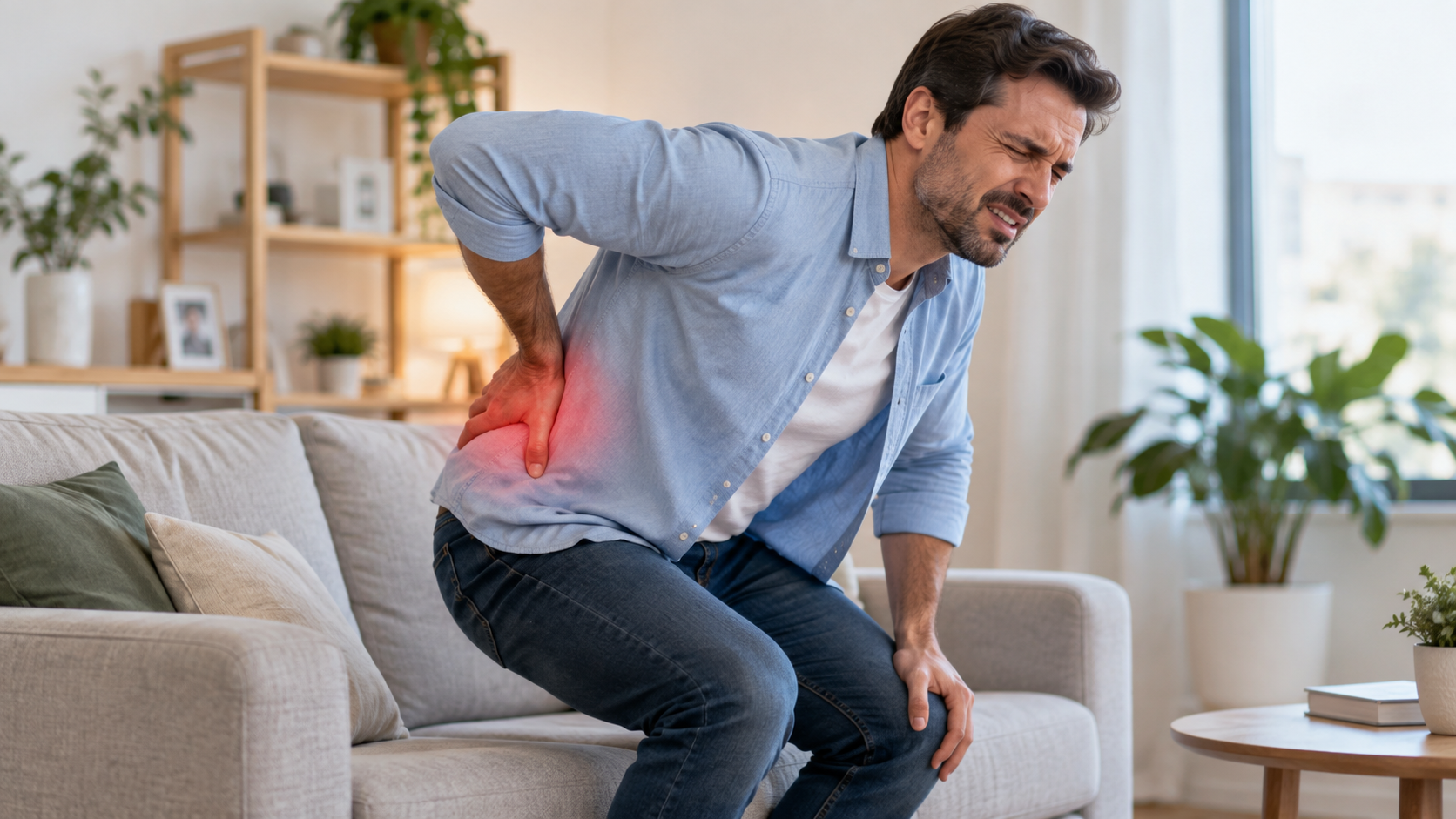
Why Does My Lower Back Hurt When I Stand Up?
You have been sitting at your desk, driving for a while, or relaxing on the couch. Everything feels relatively comfortable—until you stand up.
Suddenly, your lower back feels stiff or painful. You may need a moment to straighten completely, and the first few steps may be uncomfortable. Then, after walking around for a few minutes, your back may begin to loosen up.
Why does this happen?
Moving from sitting to standing requires coordinated movement between the lower back, pelvis, hips, and surrounding muscles. After spending an extended period in one position, the transition back to movement may make stiffness or sensitive areas more noticeable.
There is not one single explanation for this pattern. Understanding several possible contributing factors can help you determine what may be worth addressing.
Prolonged Sitting Can Make the Lower Back Feel Stiff
Sitting itself is not necessarily bad for your back. The bigger issue for some people may be spending long periods in the same position without much movement.
During prolonged sitting, the lower back, hips, and surrounding muscles remain within a relatively limited range of motion. When you suddenly stand, those areas have to transition into a different position and begin supporting your body in a different way.
If your lower back is already sensitive, this change may make stiffness or discomfort more noticeable.
This may explain why someone can feel relatively comfortable while sitting but experience pain during the first few moments after standing.
Regularly changing positions and incorporating short periods of movement throughout the day may be more helpful than trying to maintain one supposedly “perfect” sitting posture for hours.
Tight or Sensitive Lower Back Muscles May Hurt During the Transition
The muscles surrounding the lower back play an important role in stabilizing the spine and controlling movement as you move from sitting to standing.
These include the erector spinae, multifidus, quadratus lumborum, and muscles surrounding the hips and pelvis.
When these muscles become tight or sensitive, the transition from a flexed sitting position toward standing may reproduce discomfort.
Some people may also develop sensitive areas within the muscles commonly referred to as trigger points. These areas can produce local discomfort or referred pain around the lower back, hips, or nearby regions.
This is one reason the exact location where you feel pain does not always identify the only area contributing to the problem.
For people who spend many hours sitting, addressing persistent muscular tension may be an important part of managing recurring low back discomfort.
Hip Stiffness Can Place More Demand on the Lower Back
Standing up from a chair is not simply a lower-back movement.
Your hips, pelvis, trunk, and legs all work together to move your body from sitting to standing. If movement through the hips is limited or uncomfortable, the body may compensate by changing how the pelvis and lower back move.
For example, prolonged sitting may leave the muscles around the front of the hips feeling stiff. At the same time, the gluteal muscles and other muscles involved in standing must become active as you rise.
When hip mobility or muscular control is limited, the lower back may experience additional demand during the transition.
This is why recurring low back pain may sometimes require looking beyond the painful area itself. Evaluating hip movement and the surrounding muscles can provide additional information about factors that may be contributing to the problem.
Lower Back Joints May Become Sensitive
Muscles are not the only structures involved in low back pain.
The lumbar spine contains multiple joints and other structures that help the back move while providing stability. In some people, certain positions or transitions may make these areas more sensitive.
Pain may become noticeable when standing after sitting, straightening the back, remaining upright for long periods, or performing certain movements.
However, symptoms alone usually cannot identify exactly which structure is responsible.
Two people can experience similar pain when standing up but have different contributing factors. This is one reason persistent low back pain is better evaluated based on the overall pattern rather than assuming that one specific structure is responsible.
Could Pain When Standing Up Be a Herniated Disc?
Many people with recurring low back pain worry that their symptoms automatically mean they have a herniated disc.
That is not necessarily the case.
The position of the spine changes between sitting, standing, bending, and walking. As a result, people with disc-related irritation may notice that certain positions are more comfortable than others.
Some people experience greater discomfort after prolonged sitting. Others may notice symptoms during bending, standing, or particular movements.
But pain when standing up does not automatically mean you have a herniated disc.
Muscles, joints, movement patterns, activity levels, and other factors can produce similar symptoms. If symptoms persist, become severe, or are accompanied by neurological symptoms, professional evaluation can help determine whether additional assessment is appropriate.
Why Does Low Back Pain Sometimes Improve After Walking?
One particularly common pattern is pain during the first few moments after standing that gradually improves after walking.
Movement can help the lower back and hips transition out of the position they maintained while sitting. As you begin walking, the hips, pelvis, lower back, and surrounding muscles start moving through a greater range.
For some people, the initial feeling of stiffness gradually decreases as movement becomes more comfortable.
This does not mean that walking will improve every type of low back pain. Some conditions may actually become more uncomfortable with prolonged standing or walking.
However, if your back consistently feels stiff when you first stand and then loosens after several minutes of gentle movement, that pattern is useful information to share with your healthcare provider.
Everyday Habits That May Make This Pattern Worse
Recurring low back pain is often influenced by more than one factor.
Everyday habits that may contribute to stiffness or discomfort include:
- Sitting for several hours without movement breaks
- Spending long periods in a very soft chair or couch
- Long-distance driving
- Limited movement throughout the workday
- Sudden increases in exercise or physical activity
- Repetitive heavy lifting
- Limited hip mobility
- Inadequate recovery after demanding physical activity
Rather than trying to identify one “bad posture,” it may be more useful to consider how long you remain in the same position and how much movement your body gets throughout the day.
What Can Help Low Back Pain When Standing Up?
The appropriate strategy depends on what is contributing to your symptoms, but several general habits may help reduce stiffness associated with prolonged sitting.
Try changing positions regularly instead of remaining seated for several hours at a time. Short walking or movement breaks throughout the day can give the lower back and hips opportunities to move through different positions.
When standing after a long period of sitting, allow yourself a moment to rise comfortably rather than immediately forcing your back into a large stretch.
Maintaining comfortable hip and lower-back mobility can also be helpful. Over time, appropriately strengthening the trunk, hips, and gluteal muscles may improve how the body handles everyday activities such as standing, walking, bending, and lifting.
Your workstation and chair setup may also be worth adjusting if you regularly spend long periods sitting.
Most importantly, avoid assuming that every episode of back stiffness needs aggressive stretching. If a particular movement consistently produces sharp or increasing pain, repeatedly forcing that movement may not be helpful.
How Acupuncture May Support Low Back Pain
Acupuncture may be a helpful treatment option when muscle tension, trigger points, or other musculoskeletal factors appear to be contributing to low back pain.
Rather than focusing only on the exact location where pain is felt, treatment can be individualized according to the patient's symptoms, areas of muscular tension, movement limitations, and other findings during the evaluation.
For example, tight or sensitive muscles in the lower back, hips, or gluteal region may be addressed when they appear to be contributing to discomfort during movement.
Acupuncture may also be incorporated into a broader pain-management approach alongside appropriate movement, strengthening, activity modification, and other forms of care when indicated.
When Recurring Low Back Pain Should Be Evaluated
Low back stiffness after prolonged sitting does not necessarily indicate a serious problem. However, recurring or worsening symptoms deserve appropriate evaluation.
Consider seeking professional care if pain continues to worsen, significantly limits normal activities, does not improve with reasonable self-care, or is accompanied by persistent numbness, tingling, or weakness in the leg.
Low back pain following a significant injury should also be evaluated.
Certain symptoms require more urgent medical attention. Seek prompt evaluation for new bowel or bladder control problems, significant or progressive leg weakness, numbness around the groin or saddle region, or severe back pain accompanied by significant systemic symptoms such as fever.
Understanding the pattern of your symptoms can help a qualified healthcare professional determine whether the discomfort is primarily musculoskeletal or whether additional evaluation is necessary.
Ready to Try PrimeLife Acupuncture?
Whether you're experiencing acute or chronic pain, acupuncture can help restore mobility and reduce discomfort safely and effectively.
Book your appointment today with the experts at PrimeLife Acupuncture, the top-rated acupuncture clinic in Bethesda.
Curious to learn more about how acupuncture can help with other pain-related issues? Explore our Pain Management or visit our Blog for further insights improving your well-being naturally.
Disclaimer
This website and its contents are intended for informational purposes only and are not intended to diagnose, treat, cure, or prevent any disease. Whenever possible, patients are advised to seek professional care from a qualified healthcare professional for proper medical evaluation and treatment.